


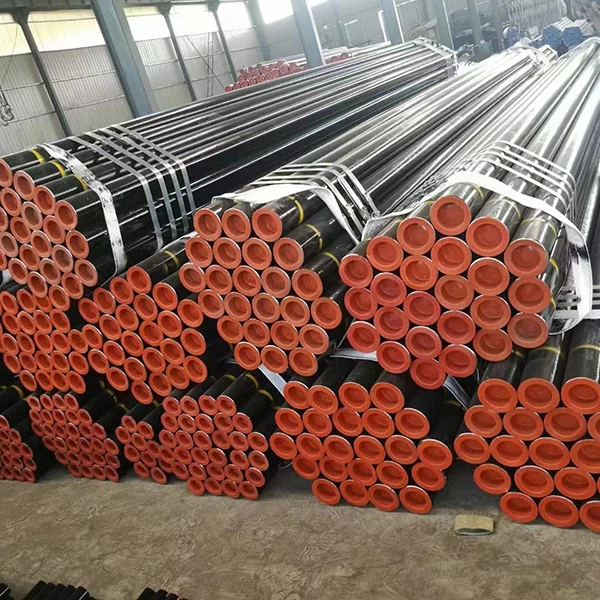
Product Name: ASTM A106 GR.C seamless pipe
Dimension and Wall Thickness
Seamless: 1/2"~24" (DN15~DN600) SCH5~SCH XXS
End connection:PE or BE
Marking: according to customer's...

Steel Pipe
Your Professional Steel Pipe Supplier
Shanghai KAIKE Pipe Technology Co., Ltd. is a reputable AAA listed pipe fittings manufacturer in China,covering an area of 66666㎡ (80000+ ㎡in stage II) and with technician and engineers more than 30 personal. Its main products include BW pipe fittings(SMLS or welded), steel flange, forged pipe fittings as well as prefabricated spools and manifolds,and also can produce according to customers' drawings and requirements.
Why choose us
Our Certifications
KEK has obtained ISO9001, ISO14001, ISO18001, CE/PED, API certification and TS pressure pipe component special equipment manufacturing license, as well as Russia's EAC continuous certification.
OEM/ODM Service
OEM and ODM are both acceptable. The material, color, style can customize, the basic quantity we will advise after we discuss.
After-sale service
We have a complete after-sales service system, so you can purchase with confidence.
-
![ASTM A106 GR.C Seamless Pipe]()
-
![Stainless Steel 316L SMLS Pipe]() Stainless Steel 316L SMLS PipeProduct Name: stainless steel 316L SMLS piperead more
Stainless Steel 316L SMLS PipeProduct Name: stainless steel 316L SMLS piperead more
Dimension and Wall Thickness
Seamless: 1/2”~24” (DN15~DN600) SCH5~SCH XXS
End connection:PE or BE
Marking: according to... -
![SA335 GR P91 Seamless Pipe]() SA335 GR P91 Seamless PipeProduct Name: SA335 GR P91 Seamless piperead more
SA335 GR P91 Seamless PipeProduct Name: SA335 GR P91 Seamless piperead more
Dimension and Wall Thickness
Seamless: 1/2”~24” (DN15~DN600) SCH5~SCH XXS
End connection:PE or BE
Marking: according to... -
![ASTM A333 GR6 DN600 PIPE]() ASTM A333 GR6 DN600 PIPEProduct Name: ASTM A333 GR6 PIPEread more
ASTM A333 GR6 DN600 PIPEProduct Name: ASTM A333 GR6 PIPEread more
Dimension and Wall Thickness
Seamless: 1/2”~24” (DN15~DN600) SCH5~SCH XXS
End connection:PE or BE
Marking: according to customer’s... -
![API 5L GR. X70 Seamaless Pipe]() API 5L GR. X70 Seamaless PipeProduct Name: API 5L GR. X70 seamaless piperead more
API 5L GR. X70 Seamaless PipeProduct Name: API 5L GR. X70 seamaless piperead more
Dimension and Wall Thickness
Seamless: 1/2”~24” (DN15~DN600) SCH5~SCH XXS
End connection:PE or BE
Marking: according to... -
![EFW Stainless Steel Pipe]() EFW Stainless Steel PipeProduct Name: EFW stainless steel piperead more
EFW Stainless Steel PipeProduct Name: EFW stainless steel piperead more
Dimension and Wall Thickness:
Seamless: 1/2”~24” (DN15~DN600) SCH5~SCH XXS
End connection:PE or BE
Marking: according to... -
![Stainless Steel Welded Tubes]() Stainless Steel Welded TubesProduct Name: stainless steel welded tubesread more
Stainless Steel Welded TubesProduct Name: stainless steel welded tubesread more
Dimension and Wall Thickness
Seamless: 1/2”~24” (DN15~DN600) SCH5~SCH XXS
End connection:PE or BE
Marking: according to... -
![ERW Carbon Steel Pipes]() ERW Carbon Steel PipesProduct Name: ERW Carbon Steel pipesread more
ERW Carbon Steel PipesProduct Name: ERW Carbon Steel pipesread more
Dimension and Wall Thickness
Seamless: 1/2”~24” (DN15~DN600) SCH5~SCH XXS
End connection:PE or BE
Marking: according to customer’s... -
![LSAW Carbon Pipes]() LSAW Carbon PipesProduct Name: LSAW carbon pipesread more
LSAW Carbon PipesProduct Name: LSAW carbon pipesread more
Dimension and Wall Thickness
Seamless: 1/2”~24” (DN15~DN600) SCH5~SCH XXS
End connection:PE or BE
Marking: according to customer’s... -
![X70 Welded Pipes]() X70 Welded PipesProduct Name: X70 welded pipesread more
X70 Welded PipesProduct Name: X70 welded pipesread more
Dimension and Wall Thickness
Seamless: 1/2”~24” (DN15~DN600) SCH5~SCH XXS
End connection:PE or BE
Marking: according to customer’s... -
![Carbon Steel Weld Neck Flange]() Carbon Steel Weld Neck FlangeProduct Name: carbon steel Weld neck flangeread more
Carbon Steel Weld Neck FlangeProduct Name: carbon steel Weld neck flangeread more
Dimension and Wall Thickness:
Seamless: 1/2”~24” (DN15~DN600) SCH5~SCH XXS
End connection:PE or BE
Marking: according to...


Composition of Steel Pipe
The main material of a steel pipe is steel, which is primarily composed of iron and carbon. In addition, steel also contains elements such as manganese, silicon, phosphorus, sulfur, tungsten, zirconium, and vanadium. Sometimes, to provide steel with more specific attributes, alloying elements such as chromium (Cr), molybdenum (Mo), cobalt (Co), and nickel (Ni) are also added.
Various chemical components have a significant impact on the physical properties of steel pipes.
Carbon (C): The higher the carbon content, the higher the hardness of the steel pipe. However, the toughness and weldability will decrease accordingly.
Silicon (Si): The content of silicon affects the tensile strength and cold-bending performance of steel pipes. If the content is too high, it will reduce cold-bending performance, while if the content is too low, it will affect the tensile strength.
Manganese (Mn): The content of manganese impacts the toughness and hardness of steel pipes. Excessive content can reduce welding performance.
Phosphorus (P) and Sulfur (S): The lower the content of these two elements, the better the cold-working performance of the steel pipe. However, this also leads to a decrease in welding performance.
Most Common Uses for Steel Pipe
THE CONSTRUCTION INDUSTRY
Since steel pipe is both durable and lightweight, it’s commonly utilized by the construction industry in commercial and residential buildings, as well as in industry sectors including power, water, sewer, manufacturing and more. Steel pipe is also a top choice in the construction industry because it’s resistant to rust and corrosion, meaning that it won’t require frequent repairs or replacement. This is especially important in water, plumbing and electrical systems, since leaks or breaks in the steel pipe can be both dangerous and costly.
THE OIL AND GAS INDUSTRY
Steel pipe is ideal for use in extreme conditions such as corrosive environments, low and high temperatures and high pressure. For this reason, steel pipe is prevalent in the oil and gas industry, especially in pipes like gathering lines (the tubes that transport oil or gas from the producing area to a storage facility or larger main pipeline), and pipe trunk lines (the welded, large-diameter steel pipes that are used to transport natural gas over long distances). Because of steel pipe’s durability and versatility, it can stand up to the unique needs of the oil and gas industry.
THE SHIPBUILDING INDUSTRY
The strength of steel makes it a great option for ship building since it withstands vibrations, shock and high pressure. Unlike other metals, steel with bend rather than break in extreme conditions, which means it’s less likely to crack or leak. In the shipbuilding industry, steel pipe is designed and manufactured for the boilers, super heaters and pressure systems of a ship.
THE TEXTILE INDUSTRY
The versatility of steel pipe makes it a popular choice in the textile industry for the production of bale openers, mixers, carding machines, spinning machines, winding machines and texturing machines.
THE AGRICULTURAL INDUSTRY
Steel pipe is frequently used in agricultural fittings due to its durability and ability to withstand pressure. Steel is also sometimes mixed with carbon to create a more lightweight yet sturdy agricultural fitting. Farmers and other agricultural organizations use steel pipe in dozens of applications, including tractor engines, grain elevators, field drainage systems, fertilizer applications, vent pipe systems and more.
INDUSTRIAL APPLICATIONS
Steel pipe is a common choice in manufacturing facilities, warehouses and other industrial locations because it’s rust-proof and doesn’t corrode, affording facilities a lifetime of dependable use. Round steel tubing is often used to transport liquids or gas from one area of an industrial facility to another, as well as in the construction of industry structures itself.
Steel pipe measurements
Length: This is fairly self-explanatory — it designates how long a piece of piping is, usually in standard increments.
Inside diameter (ID): The inside diameter is the distance between the inside walls. It can be thought of as how wide the opening in the pipe is.
Outside diameter (OD): The outside diameter is the distance from the outside edge to its opposite outside edge. This can be thought of as the total “height” of the pipe.
Wall thickness (WT): Similar to length, this is relatively self-explanatory and is the thickness of the piping’s wall. It is also half of the difference between OD and ID. Wall thickness is usually referred to as “schedule” which is a non-dimensional number that needs to be converted to the actual wall thickness using a chart.
Nominal pipe size (NPS): This is the metric that is most often used to convey the “size” of a pipe. However, the NPS is neither the ID nor the OD when it’s between ⅛” and 12”. This means that, while close to the actual diameter of the pipe, it’s another non-dimensional number and more of a designation rather than a measurement. Above 14” (or NPS 14), the nominal pipe size and OD are the same.
Steel Pipe Specifications
Steel pipes are classified based on various specifications that determine their suitability for different applications:
Sizes: Defined by nominal diameter (ND) or nominal pipe size (NPS), ranging from small (1/8 inch) to large (60 inches) diameters. Diameter determines the flow capacity.
Dimensions: Includes outside diameter (OD), inside diameter (ID), and wall thickness.
Weight: Determined by the pipe’s size and wall thickness, usually measured in pounds per foot or kilograms per meter. It helps determine transportation costs and structural load considerations.
Schedules: Indicates the wall thickness relative to the diameter, with common schedules including SCH 40, SCH 80, and SCH 160. Higher schedules mean thicker walls and higher pressure capacity.

Nominal pipe size & outside diameter size chart
For example, below is a table of NPS values from ½” to 3 ½” with their corresponding outside diameter:
|
Nominal Pipe Size (NPS) |
Outside Diameter (OD) |
|
½” |
0.84” |
|
¾” |
1.05” |
|
1” |
1.315” |
|
1 ¼” |
1.66” |
|
1 ½” |
1.9” |
|
2” |
2.375” |
|
2 ½” |
2.875” |
|
3” |
3.5” |
|
3 ½” |
4” |
|
Material |
Tensile Strength(MPa) |
Yield Strength(MPa) |
|
ASTM A53 Seamless and Welded Steel Pipe - Grade A |
331 |
207 |
|
ASTM A53 Seamless and Welded Steel Pipe - Grade B |
414 |
241 |
|
A106 Seamless Carbon Steel Pipe - Grade A |
330 |
205 |
|
A106 Seamless Carbon Steel Pipe - Grade B |
415 |
240 |
|
A106 Seamless Carbon Steel Pipe - Grade C |
485 |
275 |
|
A252 Piling Steel Pipe - Grade 1 |
345 |
207 |
|
A252 Piling Steel Pipe - Grade 2 |
414 |
241 |
|
A252 Piling Steel Pipe - Grade 3 |
455 |
310 |
|
A501 Hot Formed Carbon Steel Structural Tubing - Grade A |
400 |
248 |
|
A501 Hot Formed Carbon Steel Structural Tubing - Grade B |
483 |
345 |
|
A523 Cable Circuit Steel Piping - Grade A |
331 |
207 |
|
A523 Cable Circuit Steel Piping - Grade B |
414 |
241 |
|
A618 Hot-Formed High-Strength Low-Alloy Structural Tubing - Grade Ia & Ib |
483 |
345 |
|
A618 Hot-Formed High-Strength Low-Alloy Structural Tubing - Grade II |
414 |
345 |
|
A618 Hot-Formed High-Strength Low-Alloy Structural Tubing - Grade III |
448 |
345 |
Our Certificate


FAQ
We're professional steel pipe manufacturers and suppliers in China, specialized in providing high quality customized service. We warmly welcome you to wholesale high-grade steel pipe at low price from our factory. Contact us for cheap products.
saw steel pipe, welded steel pipe, spiral welded steel pipe